Tag: Home

365 Snap Shots of Life: Day 95

Today started out quite disappointing but along the way I managed to pull myself up by my bootstraps…with a little help of course!  First I was disappointed about something I was really looking forward to doing soon but it’s on hold for now. Then later on in the day I found out some disappointing news. I had enough of it and I decided to take a long nap. Then my daughter invites me out for a late lunch early dinner which I guess you could call it “brinner” 🙂

Sometimes God wants to bless you through your kids and I say let them! Don’t be proud, humble yourself and receive their blessing, they’re just trying to give back a little of what you gave them.

Walking home from the Mexican restaurant we ate at, my daughter asks me,” What is honorable these days mom?” I want to share a list of things I believe are honorable and if you come up with some of your own, good for you!

WHAT IS HONORABLE:

1. Working your problems out with a difficult spouse so your children can see that there are adults who care enough to work things out. This also shows them marriage is no picnic at times.

2. Honoring your dreams by pursuing them.

3. Telling the truth even if you risk losing someone.

4.Telling your kids the truth instead of always acting like everything is fine and trying to protect them. Your kids see right through you anyways and they know you’re only protecting yourself. Also, no one was ever hurt from knowing too much truth; it’s the lies that do the most damage.

5. Telling some one you love them even if they don’t reciprocate it.

6. Being able to love that person who hurt and traumatized you.

7. Forgiving yourself fully.

8. Embracing yourself with all of your quirks.

9. Not running away from life.

10. After a relationship dies, still having hope that you will find love again.

365 Snap Shots of Life: Day 86

CONTENTMENT IS A GIFT

I went to the store yesterday and I bought a wind chime and a hummingbird feeder. Once back home, I put the wind chime on my deck in the back yard. I hung the feeder from a limb on my olive tree with hopes that they’ll come to visit me. Then after dinner I sat on the swing listening to my wind chime sing as the wind caressed the pipes. My son came out and sat next to me. He said he found it amazing that I take pleasure in such simple things. And I told him it’s because I’m the kind of person who can enjoy a $10 wind chime more than a big screen TV.  Why is that?

I found out a long time ago that contentment is a choice as well. When my kids were all in the toddler stage, there were days where I found it hard to be content because back in those days they were my main focus. I had no time for myself and when I did make time it was to gather my scattered thoughts on paper to try to make sense of what was happening inside of me. That’s when I decided to purposefully sit back and watch my kids play and interact together and that day I found a sweetness in my choice to be a stay at home mom.

Not too long after that, I would listen to Joyce Meyer on the radio and she’d talk about being content no matter where you are in life. Gee,  everyday I tuned in , it was the same message. Being a quick study, I caught on that I was right where I needed to be and that in order to be content in my present state, I had to appreciate it first. So I decided to get down with my little ones and finger paint with them. This is what awakened the artist that I’d never dreamed I was before. Contentment brought me to a place of self-discovery and I’m so glad I chose to make friends with her. She’s a gift that keeps on giving!

So I invite you dear reader to examine your life and see if you’re lacking contentment, ask yourself what can you do about it. What’s robbing you of finding true contentment? If you’re content already, hang on to it no matter what because you and I both know it took some time and struggle to attain it.

365 Snap Shots of Life: Day 64

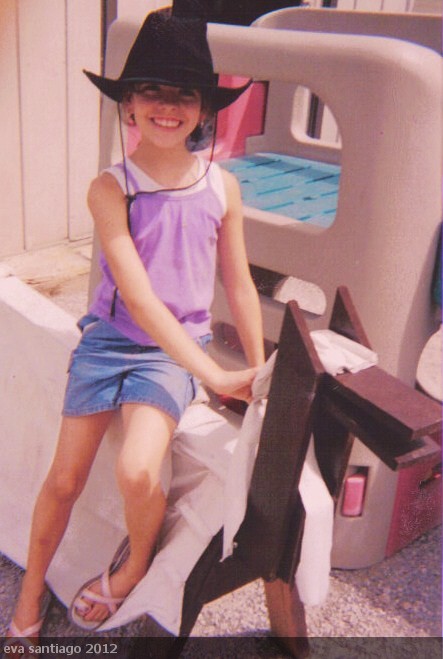
THE HORSE THAT DAVE BUILT

When my kids were all at the age when they think you can do anything, they asked me to make them a horse. At that time they were all in love with Zorro and anything to do with horses. I am not at all handy with tools,but I did try to assemble a horse out of scrap wood their dad kept in the shed. Needless to say, it was a huge failure. When their dad came home that night, I turned the project over to him and he looked at me as if I had lost my mind. He laughed at my poor attempt but then he went to the shed and brought out more wood and he made a horse as our kids watched him. When he finished it a short while later, they all squealed in delight. That wood horse brought many smiles to my kids for a long time after that. Happy Sunday everyone

-Eva Santiago copyright 2012

365 Snap Shots of Life Blog Challenge: Day 15

January 15,2012

The End

My daughter Esther has always had a fascination with horses. I would hear well meaning people tell me that it’s natural for young girls to have a love of horses. Well, she’s not so little anymore and she still adores them. I used to feel badly that I don’t have the money to get her one. As parents we wish we could give our kids everything they want. But one day I remembered what my uncle in whose home I grew up in told me when I was a kid: ” If I gave you all the things you want, you wouldn’t have anything to look forward to when you’re grown up.”  So one day I told  that to my girl  and she looked up at me with those gorgeous long eyelashes that could sweep the moon right into my hands and she said,” It’s ok Mama, I understand. So could you draw me one instead? ”  I told her I wasn’t sure I could do that and she said she knew I could since she’s seen my other art work. So I set about to do it and I pulled it off! Stay tuned because tomorrow that will be the picture I post. It’s wonderful when your own kids believe in you!

Parents DO Know Best!

I saw this article today and I had to share it on my blog . When my 17-year-old daughter was born, I received some of the wackiest advice from some well-meaning people. I had to ignore most of it though and go with my gut instinct. I even had my uncle who is a doctor, give me a wall clock so that I could put my new-born on a nursing schedule right away. Because he said, “You let that baby know who is in charge right away or she’ll ruin your life.” WOW! How could my baby, my flesh and blood ruin my life? 

So I defied all  the advice that came from others and I listened to my  instinct. This article about letting babies cry themselves into calm is fantastic. Back then I was 24 when I first had her.  People would tell me to just let her cry and I’d think, ‘ Ok, adults can self soothe but a baby can’t because they NEED someone there to help them LEARN to calm themselves.’ It was THAT apparent to me. So I asked my husband one day if he thought it right to let a baby cry and cry until they “get over it”. His response was simple,” When you’re upset and you come to me and ask me to comfort you, what would happen if I ignored you or told you to get over it? You’d be more upset right?” Bingo! So I never listened to anyone’s comments, I followed my instinct and soon I realized moms and dads DO know best when it comes to their kids!

by Darcia Narvaez, Ph.D.

Dangers of “Crying It Out”

Damaging children and their relationships for the longterm.
Published on December 11, 2011 by Darcia Narvaez, Ph.D. in Moral Landscapes

Letting babies “cry it out” is an idea that has been around since at least the 1880s when the field of medicine was in a hullaballoo about germs and transmitting infection and so took to the notion that babies should rarely be touched (see Blum, 2002, for a great review of this time period and attitudes towards childrearing).

In the 20th century, behaviorist John Watson, interested in making psychology a hard science, took up the crusade against affection as president of the American Psychological Association. He applied the mechanistic paradigm of behaviorism to child rearing, warning about the dangers of too much mother love. The 20th century was the time when “men of science” were assumed to know better than mothers, grandmothers and families about how to raise a child. Too much kindness to a baby would result in a whiney, dependent, failed human being. Funny how “the experts” got away with this with no evidence to back it up! Instead there is evidence all around (then and now) showing the opposite to be true.

 A governmet pamphlet from the time recommended that “mothering meant holding the baby quietly, in tranquility-inducing positions” and that “the mother should stop immediately if her arms feel tired” because “the baby is never to inconvenience the adult.”  Babies older than six months “should be taught to sit silently in the crib; otherwise, he might need to be constantly watched and entertained by the mother, a serious waste of time.” (See Blum, 2002.)

Don’t these attitudes sound familiar? A parent reported to me recently that he was encouraged to let his baby cry herself to sleep so he “could get his life back.” 

With neuroscience, we can confirm what our ancestors took for granted—that letting babies cry is a practice that damages children and their relational capacities in many ways for the long term. We know now that letting babies cry is a good way to make a less intelligent, less healthy but more anxious, uncooperative and alienated person who can pass the same or worse traits on to the next generation. 

The discredited behaviorist view sees the baby as an interloper into the life of the parents, an intrusion who must be controlled by various means so the adults can live their lives without too much bother. Perhaps we can excuse this attitude and ignorance because at the time, extended families were being broken up and new parents had to figure out how to deal with babies on their own, an unnatural condition for humanity–we have heretofore raised children in extended families. The parents always shared care with multiple adult relatives.

According to a behaviorist view completely ignorant of human development, the child ‘has to be taught to be independent.’ We can confirm now that forcing “independence” on a baby leads to greater dependence. Instead, giving babies what they need leads to greater independence later. In anthropological reports of small-band hunter-gatherers, parents took care of every need of babies and young children. Toddlers felt confident enough (and so did their parents) to walk into the bush on their own (see Hunter-Gatherer Childhoods, edited by Hewlett & Lamb, 2005).

Ignorant behaviorists then and now encourage parents to condition the baby to expect needs NOT to be met on demand, whether feeding or comforting.  It’s assumed that the adults should ‘be in charge’ of the relationship.  Certainly this might foster a child that doesn’t ask for as much help and attention (withdrawing into depression and going into stasis or even wasting away) but it is more likely to foster a whiney, unhappy, aggressive and/or demanding child, one who has learned that one must scream to get needs met. A deep sense of insecurity is likely to stay with them the rest of life.

The fact is that caregivers who habitually respond to the needs of the baby before the baby gets distressed, preventing crying, are more likely to have children who are independent than the opposite (Stein & Newcomb, 1994). Soothing care is best from the outset. Once patterns get established, it’s much harder to change them.

We should understand the mother and child as a mutually responsive dyad. They are a symbiotic unit that make each other healthier and happier in mutual responsiveness. This expands to other caregivers too.

One strangely popular notion still around today is to let babies ‘cry it out’ when they are left alone, isolated in cribs or other devices.  This comes from a misunderstanding of child and brain development.

  • Babies grow from being held. Their bodies get dysregulated when they are physically separated from caregivers. (See here for more.)
  • Babies indicate a need through gesture and eventually, if necessary, through crying. Just as adults reach for liquid when thirsty, children search for what they need in the moment. Just as adults become calm once the need is met, so do babies.
  • There are many longterm effects of undercare or need-neglect in babies (Dawson et al., 2000).

What does ‘crying it out’ actually do to the baby and to the dyad?

Neurons die. When the baby is stressed, the toxic hormone cortisol is released. It’s a neuron killer. A full-term baby (40-42 weeks), with only 25% of its brain developed, is undergoing rapid brain growth. The brain grows on average three times as large by the end of the first year (and head size growth in the first year is a sign of intelligence, Gale et al., 2006). Who knows what neurons are not being connected or being wiped out during times of extreme stress? What deficits might show up years later from such regular distressful experience?

Disordered stress reactivity can be established as a pattern for life not only in the brain with the stress response system, but also in the body through the vagus nerve, a nerve that affects functioning in multiple systems (e.g., digestion). For example, prolonged distress in early life, resulting in a poorly functioning vagus nerve, is related disorders as irritable bowel syndrome (Stam et al, 1997). See more about how early stress is toxic for lifelong health from the recent Harvard report, The Foundations of Lifelong Health are Built in Early Childhood).

Self-regulation is undermined. The baby is absolutely dependent on caregivers for learning how to self-regulate. Responsive care—meeting the baby’s needs before he gets distressed—tunes the body and brain up for calmness. When a baby gets scared and a parent holds and comforts him, the baby builds expectations for soothing, which get integrated into the ability to self comfort. Babies don’t self-comfort in isolation. If they are left to cry alone, they learn to shut down in face of extensive distress-stop growing, stop feeling, stop trusting (Henry & Wang, 1998).

Trust is undermined. As Erik Erikson pointed out, the first year of life is a sensitive period for establishing a sense of trust in the world, the world of caregiver and the world of self.  When a baby’s needs are met without distress, the child learns that the world is a trustworthy place, that relationships are supportive, and that the self is a positive entity that can get its needs met. When a baby’s needs are dismissed or ignored, the child develops a sense of mistrust of relationships and the world. And self-confidence is undermined. The child may spend a lifetime trying to fill the inner emptiness.

Caregiver sensitivity may be harmed. A caregiver who learns to ignore baby crying, will likely learn to ignore the more subtle signaling of the child’s needs. Second-guessing intuitions to stop child distress, the adult practices and increasingly learns to “harden the heart.” The reciprocity between caregiver and babu is broken by the adult, but cannot be repaired by the young child. The baby is helpless.

http://www.psychologytoday.com/blog/moral-landscapes/201112/dangers-crying-it-out

30 Day Blog Challenge: Day 28

Day 28 Question 28: What do you remember most about your first Christmas as a mom or dad?

Answer: Looking back now that we have 4 kids and our oldest is 17, I had to really pause and think on this question.  At that time I chose to be a full time stay at home mom and our finances were cut in half. When Christmas came around all I cared about was that I had a family of my own. We put up a tree and decorated our home as usual. My husband kept apologizing because he felt bad since he couldn’t buy us  any presents. I really didn’t care, I had a 4 month old baby girl in my arms and that’s all that mattered.

God sends people to bless us and when He does, we can’t act foolish or proud and not receive their blessing. Did you know that when someone is trying to bless you and you refuse them;  you are robbing that person of their blessing? I learned about that in those days. Sometimes you have to humble yourself and receive.

That same year we had some friends who were struggling financially too. They had a baby girl who was a few months older than mine and 2 older boys. When Martin called my husband a couple of days before Christmas and told him they had no food we  moved to help. I looked in my pantry and fridge and thanked God that they were full.

My husband had a collection of vinyl records back then. It was his dream to open a store and he had amassed enough to do so. Whenever we were short on cash, he would sell his records to tie us over until his next pay check. He took some records and sold them. When he returned he was so happy because he was able to give some of his earning to our friends in need. When we showed up at their home with a check in hand, our friends were so happy. That made OUR Christmas.

On Christmas Day we went to church. Our friends Jan & Alan were asking us about our Christmas.  We both joked that we were so broke, we had passed on giving ourselves any presents this year. Then My husband shared about how we had helped our other friends the day before. After church we were driving away and Jan & Alan were right behind us. They motioned us to pull over and we did. Jan told me to open my hand and when I did, she pressed a fresh new $100 bill into my gloved hand and wished us both a Merry Christmas. Before I could even say thanks, they had sped away. I cried that morning and I think I saw a couple of tears on my husband’s face too. Ok, I just had to stop and wipe my eyes just now too :,)

When you are good to others, God never overlooks it. When you give out of the little  that you have, it makes God smile. God’s goodness never gets old. I would love to hear some of your stories, so please feel free to comment and share. I hope you are enjoying this season!

30 Day Blog Challenge: Day 21

Please refer back to my earlier posts and read what this challenge is about so that the later posts make sense 🙂

Day 21 Question #21: What is the greatest lesson your children have ever taught you?

Answer: The one thing  I have learned after all these years of raising kids is how amazingly resilient their spirits are. When something bad happens they shrug it off more readily and easily than adults. I have asked my kids through the years to think back about when we were going through a rough spot, as a family or in my marriage to their dad. Their answers amaze me because I used to think that they would remember all the bad stuff in detail. Their answers that reflect that even though they knew times were bad, they took the good memories and cling to them. With the not so good things, they talk about it candidly and even laugh about some of the outlandish things they’ve seen.
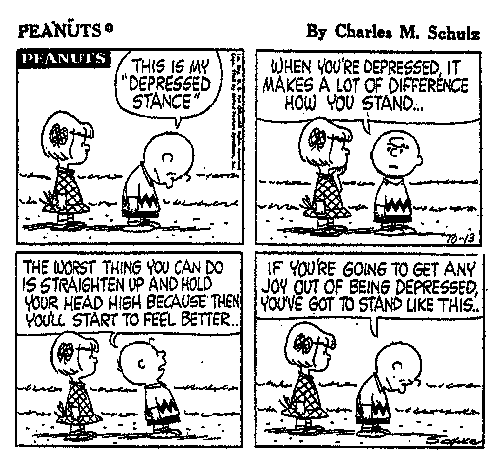
A child’s bounce back ability is so amazing to me. I have seen each of my kids go through a terrible disappointment and be completely heart-broken and frustrated, only to shrug it off the next day. They move on quickly where adults linger in things that ought be discarded. That’s one of the biggest things I have learned from my kids. If things don’t happen like I thought they were going to, I follow their example; cry, shrug and move on.

30 Day Blog Challenge : Day 14

Please refer back to my earlier posts and read what this challenge is about so that the later posts make sense. 🙂

Day 14 Question #14: If you were making a list of your 3 favorite childhood memories, what would the entries be?

Answer: I thought of  this a  little while and here are my answers.The first one was when a poem of mine won an honorable mention in a local library contest. My 6th grade teacher, Mrs Gillard sent the poems in without my knowing it and then one afternoon she handed me a white piece of paper with the directions to go to the library and pick up my certificate. I never forgot that feeling that came with knowing that someone had read my work titled, ” The Fat Cat” and liked it enough to give me an honorable mention.

My second memory was when I was 13 and I received my fist pay check for baby sitting. I baby sat a 6 month old baby boy for the whole summer and the parent would pay me by check every Friday. I felt really grown up when I took the money and opened my first bank account.

My 3rd memory was my prom. I had worked hard that year to save my money so I could buy a dress, pay for the tickets and have a nice dinner. I learned that if I wanted anything in this life I didn’t mind working hard to get it.